
Thought Leadership
Black Friday Strategies for Retailers: Post-Event Analysis to Improve Holiday Operations
September 22, 2025 in Field Managing in Retail, Retail Execution, Thought Leadership

Black Friday is not the finish line for retailers. It is the start of the holiday season. Data from sales performance, staffing allocation, inventory management, and customer behavior provides a blueprint for improving operations through December. Executives who implement Black Friday strategies for retailers based on these insights can reduce costs, improve efficiency, and enhance customer experience.
Why post Black Friday strategies for retailers matter for holiday operations
Black Friday exposes the true pressure points in retail operations. The stakes are high: traffic surges, staff are stretched, and fulfillment channels are tested at scale. This makes it one of the most valuable learning opportunities of the year.
Key reasons analysis matters:
–Real-world stress test – Unlike pilot programs or forecasts, Black Friday reveals how systems perform under maximum pressure.
–Customer signals – Shopper feedback, both direct and on social channels, highlights service gaps and unmet needs.
–Labor performance – Scheduling, training, and agility are put to the test, showing where efficiency breaks down.
–Operational readiness – From inventory allocation to checkout technology, weaknesses become visible.
A strong post-Black Friday strategy turns this insight into improvements that directly affect December’s performance.
Labor efficiency in post-Black Friday strategies for retailers
Labor is typically the largest controllable expense—and one of the most visible to customers. Post-Black Friday retail analysis should go beyond coverage counts to understand how labor was deployed.
Questions executives should ask:
-Did labor hours match the busiest traffic windows?
-Where were associates overstaffed or underutilized?
-How effective was seasonal staff training?
-Were managers agile in reallocating staff when customer demand shifted?
-Did labor costs align with sales productivity?
Example: If conversion rates dipped despite high staffing, training may need to be adjusted. If checkout times spiked, staff allocation to registers may need refinement.
Analyzing labor efficiency allows retailers to recalibrate schedules, strengthen cross-training, and improve real-time decision-making for the rest of the holiday season.
Recovery planning: Post-Black Friday Strategies
The days after Black Friday are a reset point. How quickly retailers recover determines momentum heading into December. Recovery planning is a critical component of Black Friday strategies for retailers.
Effective recovery plans focus on:
–Inventory replenishment: Restock fast sellers immediately to avoid empty shelves during Cyber Week.
–Returns processing: Dedicate staff to returns and exchanges to minimize customer frustration and speed inventory back to floor.
–Staff rotation: Avoid burnout by balancing hours for associates who worked peak shifts.
–Store resets: Update layouts to reflect trending products and create smoother traffic flows.
Retailers who delay recovery risk starting December at a disadvantage—with tired staff, low stock, and operational inefficiencies.
How to apply post-Black Friday insights to holiday retail operations
Executives should treat Black Friday as a blueprint for the remainder of the holiday season. Instead of waiting for post-season reviews, use findings immediately.
Key applications include:
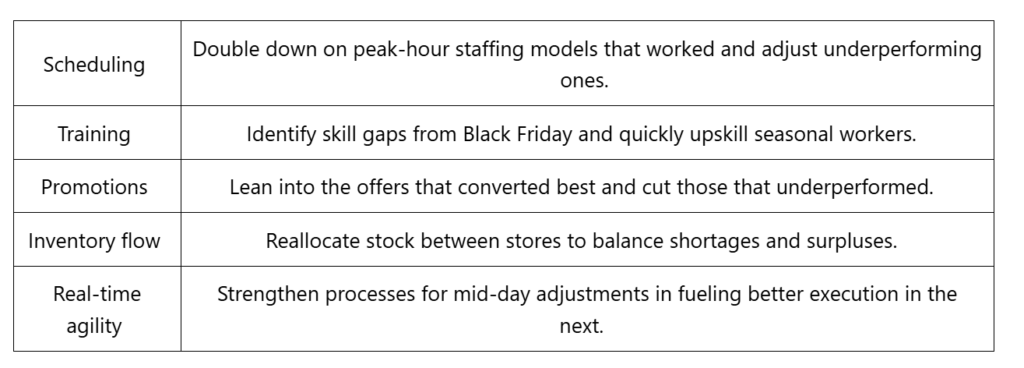
This creates a cycle of continuous improvement, with each peak event fueling better execution in the next.
Common mistakes to avoid in post-Black Friday retail strategies
Retailers often miss opportunities by making these mistakes:
–Over-focusing on one-day anomalies instead of multi-day patterns.
–Failing to adjust schedules in real time when customer traffic shifts.
–Ignoring associate feedback, which often points to pain points before metrics confirm them.
–Treating Black Friday as an isolated event, instead of a lesson for the rest of the season.
Avoiding these pitfalls keeps momentum strong through December.
Checklist for executives: Post-Black Friday retail strategies
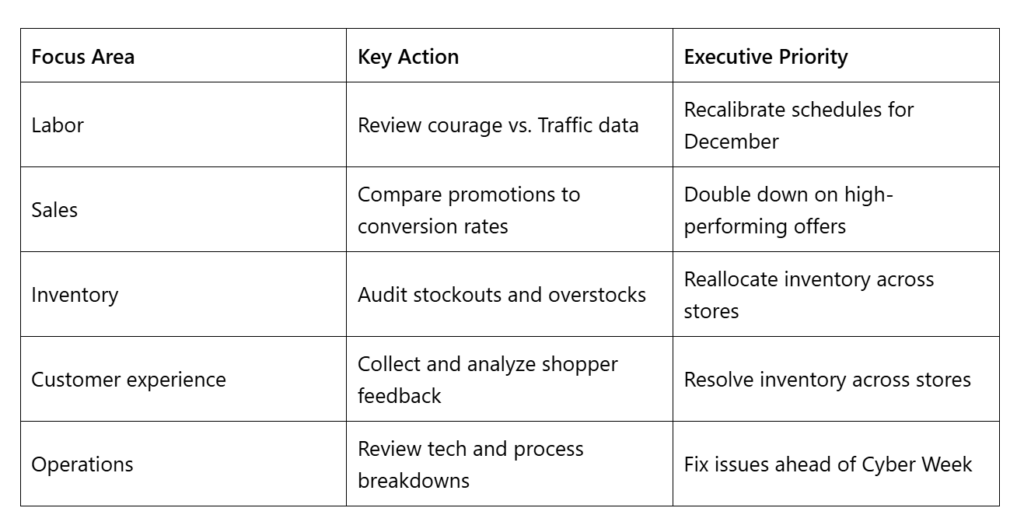
Optimizing holiday retail operations after Black Friday: Key takeaways
Black Friday is more than a sales spike. It is a stress test that shows how well retail operations, staffing, and customer service perform under peak pressure. The retailers who succeed are the ones who use Black Friday as the blueprint for the rest of the season.
By applying post-Black Friday strategies for retailers such as refining labor models, adjusting promotions, and replenishing inventory quickly, executives can build momentum for December and finish the year stronger.
Key takeaway: A strong post-Black Friday strategy provides the roadmap to optimize holiday operations, improve customer experiences, and maximize profitability through year-end.
Book a demo with us today.
Recent Blog Posts

How Pooling Labor Enhances Customer Experience
Retail will always be a business supported by the human touch – your associates on the store floor Retaining experienced and knowledgeable staff in your stores is an essential component for...
READ MORE
NRF 2026 Recap: Workforce and Retail Execution Strategy in Your Stores
The key takeaway from NRF this year is clear: boosting performance in your stores is the next competitive edge Let’s be honest, retail has seen its fair share of big tech...
READ MORE
10 Signs Your Stores are Falling Behind on Peak Prep (and How to Improve Retail Execution)
Even after the holiday rush, many retailers assume “slow season = easy season” The truth February is prime time to assess retail peak prep and identify gaps in store...
READ MORESchedule a Consultation With Our Retail Experts Today
Contact us today for a 15-minute conversation on how StoreForce can help you drive store performance and execution for less than the cost of 1 transaction per week. Learn how retailers all over the world are driving performance and customer experience through our solution made exclusively for Specialty Retail.